Scam & Fraud Checks
ZCrime: Website, Store, Phishing, and Link Scam Checks
What ZCrime is
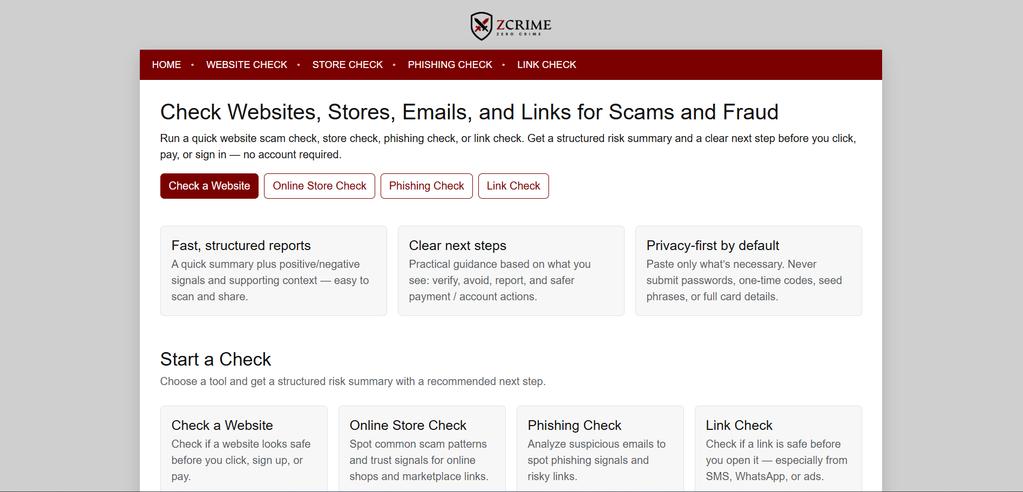
ZCrime is a practical scam and fraud checking platform built to help people make safer online decisions before they click, pay, or share sensitive information. Instead of presenting raw technical data, the platform delivers structured reports with clear risk signals and a recommended next step.
ZCrime focuses on four common high-risk scenarios: checking a website, verifying an online store, analyzing suspicious emails for phishing signals, and evaluating links received via SMS, WhatsApp, social media, or ads.
Project website: https://zcrime.com/
Core tools
- Website Scam Check — evaluates common website risk signals before sign-up or payment (domain cues, HTTPS/certificate basics, metadata signals, and typical scam patterns).
- Online Store Check — flags common e-commerce scam patterns and trust signals, with safer payment guidance and refund/chargeback considerations.
- Phishing Check — analyzes suspicious emails using the full email source (headers + body) to extract sender details, routing cues, and risky links.
- Link Check — reviews URLs before you open them, focusing on redirects, destination domain signals, and URL-based scam patterns.
Report format
ZCrime reports are designed to be fast to scan and easy to share. Output is structured into clear blocks, typically including a short summary, positive and negative signals, supporting context, and a recommended next step (for example: verify, avoid, or report).
This format is intentional: most users are trying to decide what to do in the next few minutes, not read a long technical assessment.
Why this approach works
Modern scams are not limited to obvious spam. They appear as realistic stores, look-alike domains, shortened links, and convincing “account locked” or “delivery failed” messages. A structured check that highlights suspicious patterns can reduce impulsive actions and improve safety outcomes.
ZCrime does not claim perfect detection. Scam infrastructure changes quickly, and no automated tool can guarantee safety. The goal is practical decision support: help users verify what they can, avoid risky steps, and take action faster when something goes wrong.
Privacy-first by design
ZCrime is built with a privacy-first mindset. Users should paste only what is needed for analysis — such as a URL, domain, or email source. The platform does not ask for passwords, one-time codes, seed phrases, or full card/banking details, and users are explicitly warned not to submit them.
Who the platform is for
- People verifying an unfamiliar website or shop before paying.
- Users who received a suspicious email and want to check for phishing signals.
- Anyone who needs to evaluate a link received via SMS, messengers, social media, or ads.
- Support teams and communities that share reports to explain risks and next steps.
Simple workflow
- Choose the relevant tool (website, store, email, or link).
- Submit only the required input (URL/domain or full email source for phishing).
- Review the summary and key signals.
- Follow the recommended next step: verify via official channels, avoid the action, or report the incident.
FAQ
Does ZCrime guarantee that something is safe?
No. ZCrime provides guidance and risk signals, not a guarantee or legal determination. Always verify via official sources before paying or entering credentials.
What should I do if I already paid or entered credentials?
Act quickly. Contact your bank or payment provider, report the incident to the relevant platform, change passwords for affected accounts, enable 2FA, and preserve evidence (receipts, emails, screenshots, links).
Can I paste a message from WhatsApp/SMS into Phishing Check?
Phishing Check is optimized for email analysis and requires full email source data (headers + body). For links received via SMS or messengers, use Link Check.
Visit ZCrime
Official website: https://zcrime.com/
If you need a similar safety-focused platform with SEO-ready architecture, structured reporting, and privacy-first UX, contact Ritkey via the contact page.