PHOTOGRAPHY DATA & TOOLS
PhotoDataLab: Professional Photography Data, EXIF Tools and Real-World Camera Insights
Project overview
PhotoDataLab is a data-driven photography platform developed by Ritkey around a simple idea: photography advice is more useful when real-world observations are shown alongside the usual recommendations.
The project combines practical browser tools with a structured photography data reference. Its dataset covers more than 166,000 photographs from over 1,000 professional photographers, allowing PhotoDataLab to surface observed camera usage, lens pairings, exposure settings, focal lengths, genre patterns and dataset-quality context.
Rather than presenting a single setting as universally “best”, PhotoDataLab distinguishes between what was observed in the data and what might be recommended in a specific shooting situation.
EXIF Viewer: inspect photo metadata locally
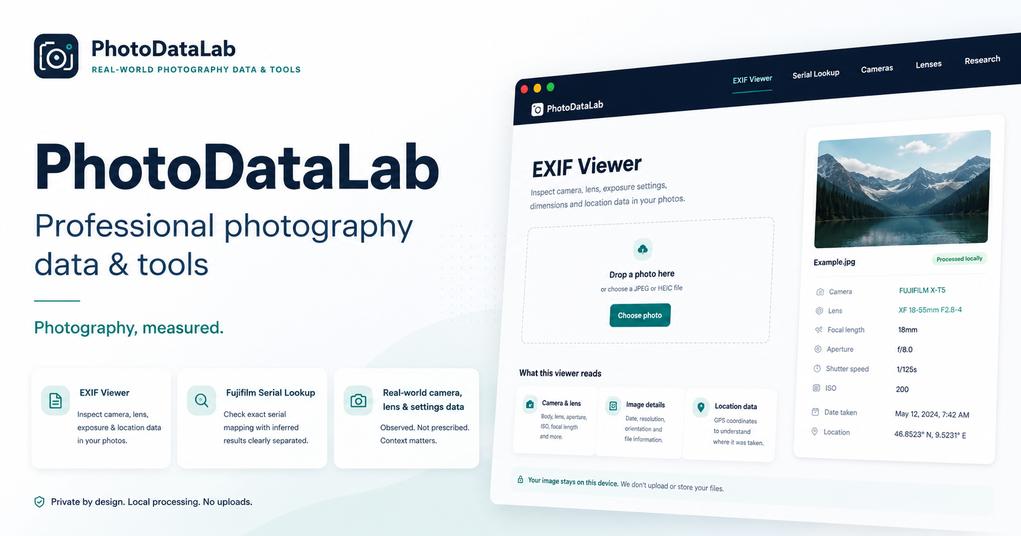
One of PhotoDataLab’s primary tools is a browser-based PhotoDataLab EXIF Viewer for JPEG and HEIC/HEIF files. It reads available camera, lens, ISO, aperture, shutter speed, focal length, image dimensions, date, software and GPS metadata directly in the user’s browser.
Privacy is part of the product design: the selected image and extracted GPS coordinates are not uploaded to PhotoDataLab. When a recognized camera or lens is detected, the viewer can connect the result to the corresponding real-world data page inside the project.
Real-world camera, lens and photography settings data
PhotoDataLab turns structured photography metadata into dynamic reference pages for cameras, lenses and photography genres. These pages summarize observed ISO, aperture, shutter-speed and focal-length distributions, commonly paired lenses, sample sizes, contributor diversity and other data-quality signals.
The project also uses photographer-balanced statistics so that one unusually large portfolio does not silently dominate a result. This makes the data more useful as a reference while keeping the methodology transparent about what the dataset can and cannot establish.
The result is a programmatic data product rather than a collection of separately generated review articles: shared templates are populated from normalized and precomputed data, while only sufficiently supported page combinations are made indexable. Explore the professional photography data on PhotoDataLab.
Fujifilm Serial Number Lookup
PhotoDataLab also includes a Fujifilm Serial Number Lookup built from more than 13,000 unique historical serial records. Exact database matches are clearly separated from cautious prefix-based model inference, and the interface reports support and confidence rather than presenting uncertain results as facts.
The tool deliberately avoids unsupported claims about manufacturing date, warranty status, ownership or authenticity. Its purpose is to provide a practical reference for identifying known model mappings and nearby serial patterns.
Built as a useful data product, not a generic photography blog
The product architecture was designed around distinct search intents: practical tools, camera and lens reference pages, photography settings by genre, and carefully gated long-tail data pages. The goal is to make each indexable URL answer a real user question while avoiding thin combinations generated only for search engines.
Pages are dynamically backed by structured data and precomputed aggregates, with internal linking between tools, cameras, lenses and settings. Sample size, photographer count, data completeness and contributor concentration are exposed as part of the user experience rather than hidden behind a headline statistic.
Privacy-first tooling and transparent methodology
PhotoDataLab keeps the public product independent and focused on photography data. Browser tools process user-selected image metadata locally where possible, and the data-reference side of the site emphasizes observational wording, provenance, sample quality and methodological limitations.
The project does not reproduce photographers’ images as part of its data pages. Where source references are appropriate, attribution is handled through source links rather than copied photography.
Visit PhotoDataLab
Explore the live project at PhotoDataLab for browser-based photo metadata tools and real-world professional photography data covering cameras, lenses and shooting settings.