FOOD TOOLS & REFERENCE
olive oils inDIA: Practical Olive Oil Tools for Everyday Cooking
Your Olive Oil Companion
Project overview
olive oils inDIA is a focused, English-language web project developed by Ritkey to answer a deceptively simple question: which olive oil makes sense for what I'm cooking?
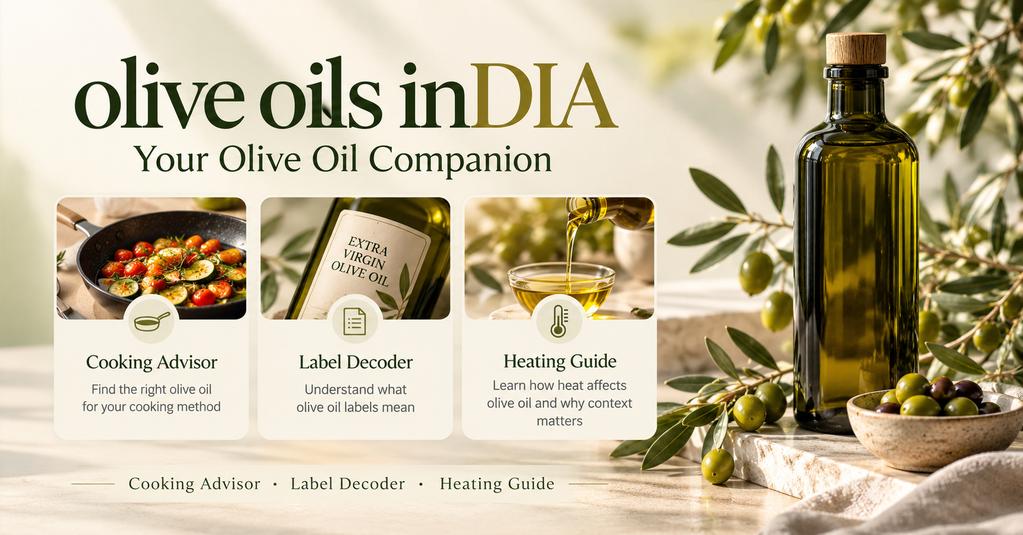
Rather than asking visitors to read a long guide before making a decision, the site starts with an interactive choice. Its Cooking Advisor, Label Decoder and Heating Guide connect everyday kitchen scenarios with clear explanations of olive oil categories, heating considerations and the limits of what can be inferred from a product label.
The product is intentionally small and easy to use on a phone. Visitors can get a practical starting point quickly, explore the reasoning behind it and move between tools without working through a long technical questionnaire.
Cooking Advisor: start with the dish
The Olive Oil Cooking Advisor begins with the way a person plans to cook: pan-frying, roasting, deep-frying, or preparing a dressing or finishing a dish. A visitor can then optionally specify the type of olive oil already in the kitchen.
Instead of declaring a single oil universally best, the tool explains the considerations that matter for the selected method. It distinguishes practical guidance from a measurement of an individual bottle and avoids invented precision. The main interaction is deliberately simple: choose a cooking method, read the result, and refine it only if needed.
Label Decoder: understand the bottle
The Olive Oil Label Decoder explains familiar terms such as extra virgin, virgin, regular olive oil, light or extra light, and olive-pomace oil. It helps users distinguish formal product categories from shorthand and marketing language.
The decoder also draws a necessary boundary: a label can describe a category, but it cannot by itself prove a particular bottle's freshness, authenticity or measured performance. From the explanation, visitors can move to the Cooking Advisor with a clearer idea of what they have.
Heating Guide: beyond one smoke-point number
The Olive Oil Heating Guide explains why generic smoke-point figures should not be treated as an exact limit for every bottle. Grade, condition and cooking circumstances affect how such information should be interpreted.
The guide puts those figures in context, covers practical heat-management considerations and avoids presenting a generic published range as a personalized safety assessment.
Designed for clarity, not complexity
The interface is built around a few deliberate choices: mobile-first layouts, concise prompts, progressive disclosure of detail, accessible links and source-backed explanations. Visitors do not need to create an account, identify a brand or know specialist laboratory values before receiving useful guidance.
Supporting educational pages explain categories and terminology in greater depth, while a published sources page makes the basis and limits of the guidance visible. This keeps the experience practical without asking users to accept a black-box recommendation.
Modern tools with respect for the domain's history
The project also preserves selected educational topics from the domain's earlier olive-oil and cultivation history. Material on olive trees, Italian olives and related subjects is maintained as useful reading rather than being replaced with irrelevant redirects. Those pages complement the newer cooking tools and offer visitors a natural path from background information to practical use.
This illustrates a broader approach to compact web products: retain relevant subject matter, build genuinely useful functionality, and keep each public page valuable in its own right.
Visit the project
olive oils inDIA is live and available in English.
Official website: https://oliveoilsindia.com/