Lost Phone Ringing Utility
Call My Number: Ring Your Own Phone Fast with Safety and Privacy in Mind
Project overview
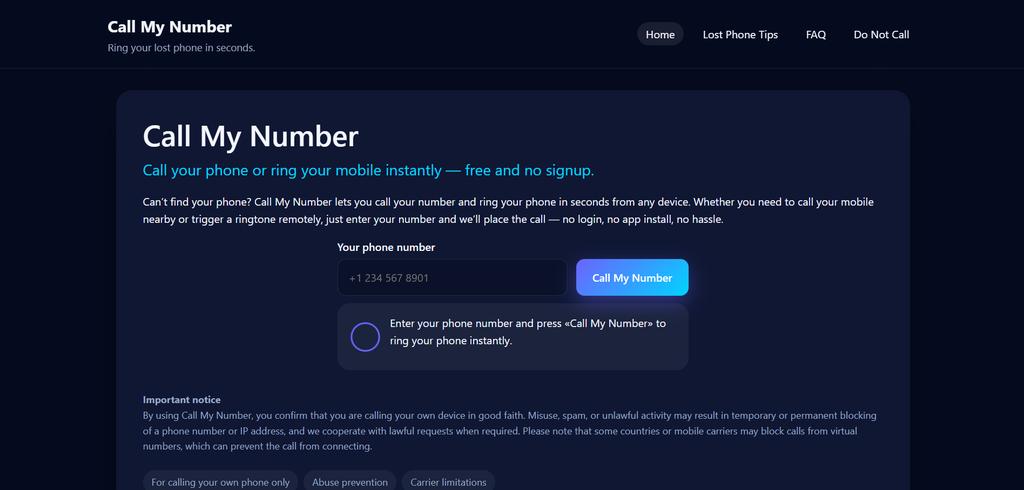
Call My Number is a focused web utility designed for a common, time-sensitive scenario: you cannot find your phone and need a fast, simple way to ring it. The project is intentionally lightweight — it runs in the browser with no app installation and no account creation — and centers on practical guidance, clear user intent, and responsible use.
The experience is built around a single action: entering your number and triggering a call attempt, with real-time status updates and clear messaging about limitations (carrier restrictions, silent-mode behavior, and cases where the phone is offline).
Core flow: ring your own phone
The primary use case is straightforward: the user rings their own device and listens for the ringtone or vibration to locate it nearby. The interface is optimized for speed and clarity — input, start, and immediate feedback — because lost-phone moments are typically stressful and time-critical.
The project communicates important realities up front: the phone must be powered on and have reception, and in some regions calls from certain outbound routes may be restricted by local carriers. Where silent-mode behavior varies by device and settings, the copy avoids overpromises and points users to official account-based tools when appropriate.
Related page: callmynumber.org
Live call status and user feedback
A key usability component is transparency during the call attempt. The service reports session progress (for example, preparing, dialing, in progress, finished, or cancelled) and provides next-step messaging if the call does not connect or the session expires.
This reduces confusion and helps users decide what to do next — try again later, check last known location, switch to official device-finder services, or take account-security actions.
Abuse prevention and Do-Not-Call controls
Because any call-triggering tool can be misused, Call My Number includes clear responsible-use positioning and safeguards designed to deter prank calls and harassment. This includes basic rate limiting, abuse monitoring signals, and an opt-out workflow.
The Do-Not-Call page allows a phone number to be added to an exceptions list so that future call attempts are blocked. The messaging is designed to be direct, user-friendly, and aligned with privacy expectations.
Related page: callmynumber.org/do-not-call
Privacy-first positioning
The project’s documentation emphasizes a privacy-first approach: the phone number is used only to place the requested call, not for marketing. Where operational logging is required for safety and abuse prevention, the copy explains what is stored (for example, technical metadata like IP and timestamps) and why, with references to the Privacy Policy.
This transparency is reinforced across the Privacy Policy, Cookie Policy, and Terms pages, keeping user expectations consistent with the product’s real behavior.
Related pages: Privacy Policy, Cookie Policy, Terms
Help content: lost phone tips
Beyond the call action, Call My Number provides practical, non-technical guidance for users who still cannot locate the device: retracing steps, checking last known location, securing accounts, and contacting the carrier to block a SIM when needed.
The goal is to support calm, realistic decision-making rather than presenting complex tooling or unreliable “guaranteed tracking” claims.
Related page: callmynumber.org/lost-phone-tips
Visit the project
Official website: https://callmynumber.org/
If you are interested in building similar telephony-based utilities with safety constraints, session transparency, and privacy-forward documentation, you can reach out via the contact page.